A month in Russia: the day fourteen VPNs went down
Three hours after landing, every one of my VPNs is down except one. An account of the first twenty-four hours in the most heavily filtered country on my route, and what it teaches about security on the road.
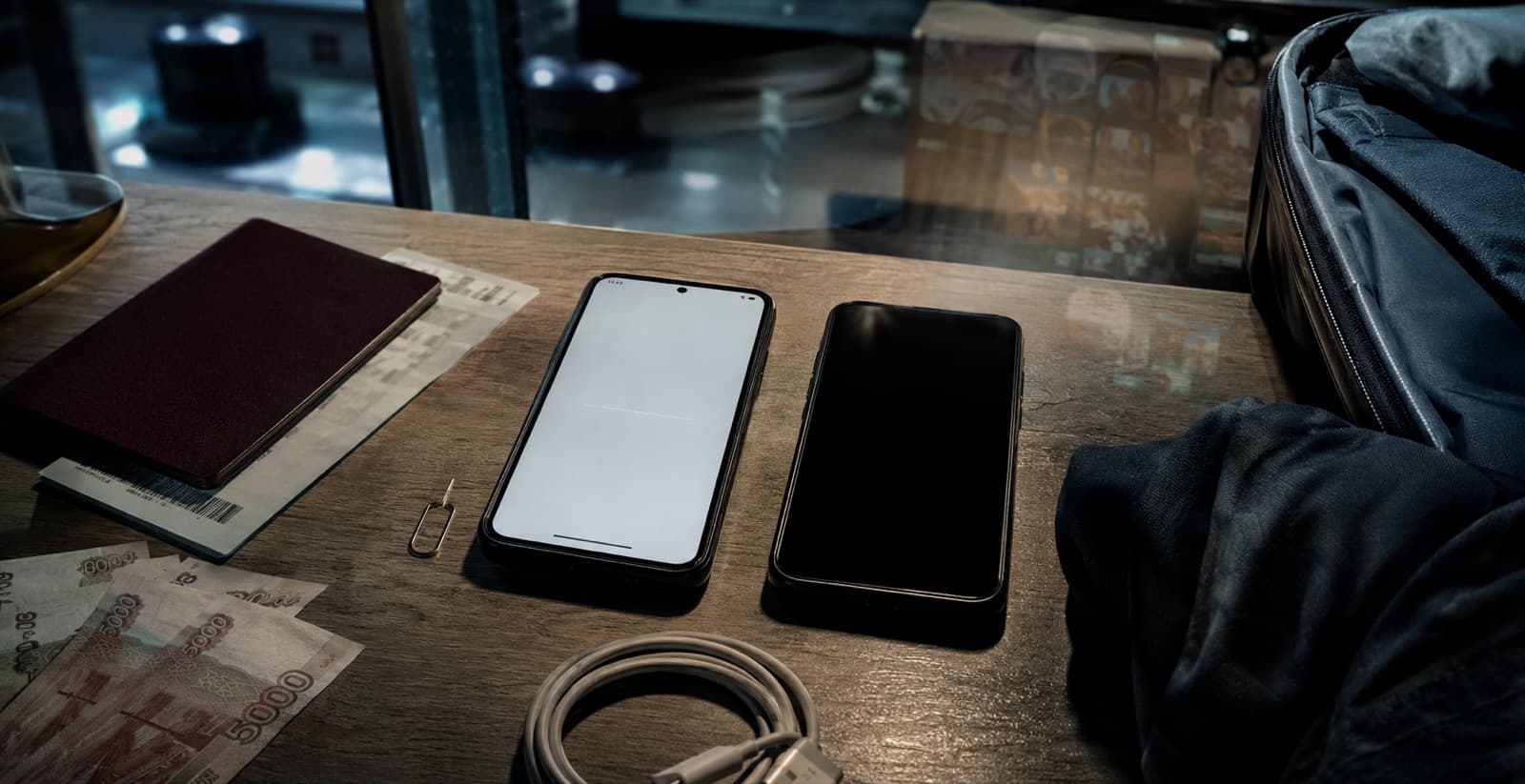
I am writing from Russia, and the first surprise is not the one I had rehearsed. For weeks I prepared for sophisticated threats, for the devices that harvest, for the networks that listen. Three hours after landing, the problem is elsewhere, dumber and more total: I simply cannot get online. Not a slowdown or a passing lag, but a complete wall.
And above all, none of my VPNs answers. Mullvad, NordVPN, ExpressVPN, ProtonVPN, down one after another. Even AmneziaVPN, which I host on my own server, a tool built precisely to get around censorship, stays mute. I ended up cobbling together a shaky connection, an unlikely setup, just to slip one foot out of the country. Roaming, for its part, is off by default for the first twenty-four hours, just to get things off to a good start.
I had to try about fifteen solutions, turn on the obfuscations, the "chameleon" modes meant to disguise the traffic as something harmless, before a single one finally got through: Mullvad, and Mullvad alone. Not because it is better in theory, but because its disguise still holds where the others get spotted and cut. That is the real state of play, the one no guide gives you: in this country, your encrypted tunnel is worth exactly what its disguises are worth, and most of them no longer fool anyone.
Two phones, never a suitcase
Let us start from the beginning, because none of this was improvised. The night before leaving, I did not pack a suitcase, I prepared two phones. One clean, almost empty, the one that can be demanded at the border and searched without finding anything. The other, the one that carries my life, my full digital alter ego, switched off and encrypted until I am somewhere safe. This is not fear, it is the reflex of politely paranoid people, those who have learned not to confuse caution with panic. And at the end of the trip there is no client and no mission, just family and a month ahead of us.
The border is no longer a stamp
The border, precisely, is no longer a simple stamp in a passport. The disguised network devices, those fake antennas that pass themselves off as an ordinary relay and harvest whatever a phone hands them the moment it connects, are still there, at customs, very much present. But let us be clear, this is not a Russian speciality. You find exactly the same setup in the United States, in Israel, in plenty of countries we more readily hold up as examples. The difference is not in the technology, it is in the number of people it bothers. Hence the rule, valid everywhere: a clean device to cross, and the real one you never switch on until you are far from the counter.
Why my tunnels fall one by one
If my tunnels fall one after another, it is no accident. For years Russian carriers have been fitted with deep packet inspection boxes, imposed across the whole country, that hunt protocols one by one and cut anything that looks like a VPN. Hundreds of services have already been blocked. Part of what you open out of habit every morning is degraded or unreachable here, Western social networks, messaging apps, entire search engines slowed to the point of uselessness. Elsewhere you are politely promised that your connection is private. Here the contract is more honest: everything that passes can be read, and a leak never dies. Public wifi, needless to say, does not exist for me.
The network that goes dark, the money that turns back to cash
There are even moments when the network shuts down entirely. In several regions, mobile internet drops all at once, and for once the reason holds up: a dead zone of a few minutes, and drones lose their bearings, unable to guide themselves or strike. The blackout is not an administrative whim, it is a shield. You learn to deal with a country that switches off its digital sky whenever it feels targeted.
The rest comes from the same learning curve. Since 2022, Visa and Mastercard cards no longer work. The gesture of paying without thinking, of pulling out your phone for a coffee, disappears. Back to cash, to making do, to that form of digital amputation that throws you off in the first days more than you would admit.
Unreachable, and therefore present
And there is a side effect I had not anticipated, one I note without making a poem of it. From cutting everything off, from distrusting every device, I put the phone down, for good. It no longer asks for anything. What remains is the table and conversations that last because nothing comes to interrupt them. The most surveilled country on my route made me, without meaning to, unreachable, and therefore present.
What you carry weighs more than the lock
We think travel security comes down to the lock on the room and the neighbourhood you avoid at night. It comes first from what you carry. A work laptop is often worth more than everything else in a suitcase, and no one declares it at customs. The traveller has become a carrier of data before being a body to keep safe, and almost no one briefs them on that.
On my way back, the clean phone will be wiped, the other treated like everything that has spent a month on these networks: reset, compromised on principle. It sounds excessive, it is a little less so here, in a country that at least has the honesty not to pretend the network is on your side. There remains this irony I half enjoy: I built a small fortress to keep my data from leaking out, and the country, for its part, solved the problem another way, by making any connection to the outside world nearly impossible. Between me and total disconnection, all that is left is a Swedish VPN and its disguises.
Questions fréquentes
Can you use a VPN in Russia?
Barely. Carriers are equipped with deep packet inspection (DPI) boxes that spot and cut VPN protocols one by one. In this account, of about fifteen tools tested, only Mullvad in obfuscated mode eventually got through; Nord, Express, Proton and even a self-hosted AmneziaVPN server stayed silent.
Do you really need two phones to travel in a heavily surveilled country?
The author recommends a clean device, nearly empty, that you can hand over and let be searched at the border with nothing to find, and a second one, encrypted and switched off until you are safe. The principle holds well beyond Russia: the devices that vacuum up data at customs also exist in the United States, Israel and elsewhere.
Why is mobile internet sometimes cut in Russia?
In several regions the mobile network is switched off for a few minutes to jam drones, which then lose their guidance bearings. The blackout works like a shield, not a mere administrative measure.

L’auteur
Christophe MazzolaJ’écris sur la cybersécurité telle qu’elle se vit vraiment : gouvernance, facteur humain, et tout ce que les rapports d’audit n’osent pas dire au COMEX. Auteur de « Être en cybersécurité ».
Être en cybersécurité
Une feuille de route cyber en clair, pour tout le monde, pas seulement les experts.